

If you’ve been thinking about moving into Data Science, Analytics, or AI lately, there’s a good chance one thought has crossed your mind.
I know this, because I get asked about it all the time.
“Is AI going to make this whole thing pointless?”
It’s a fair question.
There’s a lot of noise out there right now, especially on social media. Every day it feels like there’s a new tool, a new headline, a new claim that “Data Science is dead” or that “AI will replace you”.
And I get why people worry about it.
If AI can write Python code, create dashboards, explain statistics, build models, and answer technical questions in seconds, then surely that means the whole field is about to disappear?
Not quite.
Actually, not even close.

The reality from inside the industry
Here’s the reality from inside the industry.
And I don’t say this casually. I stay in regular contact with hiring managers, recruiters, and leaders across Data Science, Analytics, and AI, and I’m constantly paying attention to what companies are actually asking for.
AI is not making Data Scientists and Analysts pointless.
It is making the good ones more valuable.
Because the hardest part of the job was never just writing code.
Yes, coding matters. SQL matters. Python matters. Machine Learning matters.
But the real value has always come from the thinking around the work. Understanding the problem. Asking the right questions. Knowing whether the result makes sense. Communicating what it means. Helping the business make a better decision.
That’s the part people often miss.
AI can help you write code faster, explore data quicker, generate ideas, test approaches, summarise information, and even build models. But it does not remove the need for human judgement, business understanding, statistical thinking, communication, and problem solving.
In fact, it makes those things even more important.
"AI can make you faster. But it can’t replace knowing what you’re doing."
The job is changing, not disappearing
The field is not standing still.
It would be ridiculous to pretend it is.
AI is changing how Data Scientists, Analysts, Machine Learning Engineers, and AI professionals work. But that is very different from saying the field is dead.
What we’re seeing is a shift.
Companies still need people who understand data. They just increasingly expect those people to be able to work alongside AI, not compete with it.
That lines up with what broader market research is showing too. The World Economic Forum’s Future of Jobs Report lists roles such as Big Data Specialists and AI and Machine Learning Specialists among the fastest-growing jobs towards 2030, while also highlighting AI and big data as fast-growing skill areas.
So the idea that “AI means there’s no point learning Data Science” is the wrong conclusion.
The better conclusion is this:
"The people who succeed now will be the ones who combine strong Data Science foundations with the ability to use AI properly."
That is the opportunity.
Not ignoring AI. Not panicking about AI. And definitely not thinking that a few AI prompts are enough to make you professionally valuable.
The opportunity is learning the foundations properly, then using AI as an accelerator on top.
The hardest part was never just the code
One of the biggest mistakes people make right now is thinking:
“If AI can write the code, I don’t need to learn the skills.”
But that completely misses the point.
If you don’t understand Python, how will you know whether the code is correct? If you don’t understand SQL, how will you know whether the query is pulling the right data? If you don’t understand Statistics, how will you know whether a result is meaningful?
And if you don’t understand Machine Learning, how will you know whether a model is useful, biased, overfit, or completely inappropriate for the problem?
This is why foundation skills still matter so much.
Andrew Ng, one of the most recognised voices in AI, has made a similar point when talking about AI adoption in organisations: AI needs to be customised to the business context, not just downloaded and applied blindly to a problem.
That is exactly the point.
AI tools are powerful, but they are still tools. The value comes from knowing how to use them in the right context.
What hiring managers actually want
With all the hype around AI, it’s easy to feel like you need to learn everything at once.
GenAI, LLMs, agents, RAG, cloud tools, vector databases, prompt engineering, Machine Learning, Deep Learning, MLOps…
It can feel overwhelming.
But when you speak to hiring managers, what they actually want is usually much simpler than that.
They want strong foundations first.
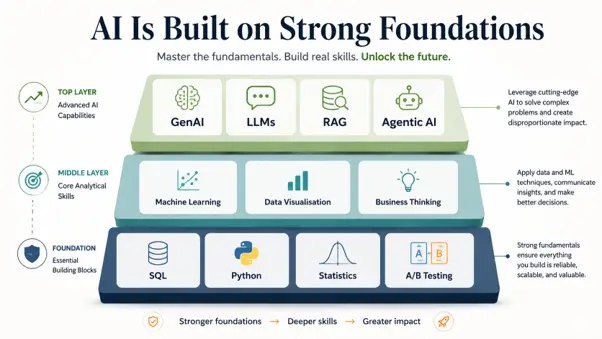
That means SQL, Python, Statistics, A/B Testing, data visualisation, core Machine Learning understanding, business problem-solving, communication, and portfolio evidence.
Then, on top of that, they want awareness of how AI fits into the picture.
Not the other way around.
Because without those foundations, AI tools are just tools you don’t really understand. You won’t know when to trust them. You won’t know when they’re wrong. And you won’t know how to use them to create real business value.
Cassie Kozyrkov, Google’s first Chief Decision Scientist, has argued that the precision thinking skills associated with classic data science training are likely to become more important, not less, as enterprise AI systems grow.
That is exactly what I’m seeing too.
So, does AI mean the end of Data Science?
No.
But it does mean the bar is changing.
The people who struggle will be the ones who only learn random tools, copy code they don’t understand, build generic projects, and assume AI will do the thinking for them.
The people who stand out will be the ones who understand the foundations, build real projects, communicate clearly, think commercially, and use AI to move faster.
That’s the difference.
AI does not make Data Science pointless.
It makes weak, shallow learning easier to spot.
And it makes strong, practical, well-rounded candidates even more valuable.
"AI is not the end of Data Science. It is the next chapter of Data Science."
The right way to learn now
So if you’re feeling unsure right now, that’s completely normal.
You do not need to learn everything at once. You do not need to be perfect. And you definitely do not need to spend the next two years jumping between YouTube videos, random courses, and AI tools hoping it all eventually comes together.
You need a clear path.
You need the right foundations, practical application, projects that show real-world value, and an understanding of where AI fits.
That is how people make this transition successfully.
Not by trying to learn everything at once. Not by ignoring AI. And not by hoping a certificate on its own will make them stand out.
They do it by building the skills, portfolio, confidence, and career strategy that the market actually rewards.
The Data Scientist 2.0 Roadmap
For The GenAI Era
Learn the AI tools, but build the fundamentals that make them useful.
Download Your Copy
Does Data Science Infinity teach AI?
Yes, absolutely.
Data Science Infinity teaches the key fundamentals of Data Science and Analytics, including SQL, Python, Statistics, A/B Testing, data visualisation, Machine Learning, and more.
But it also includes a full module on Generative AI, LLMs, and Agentic AI.
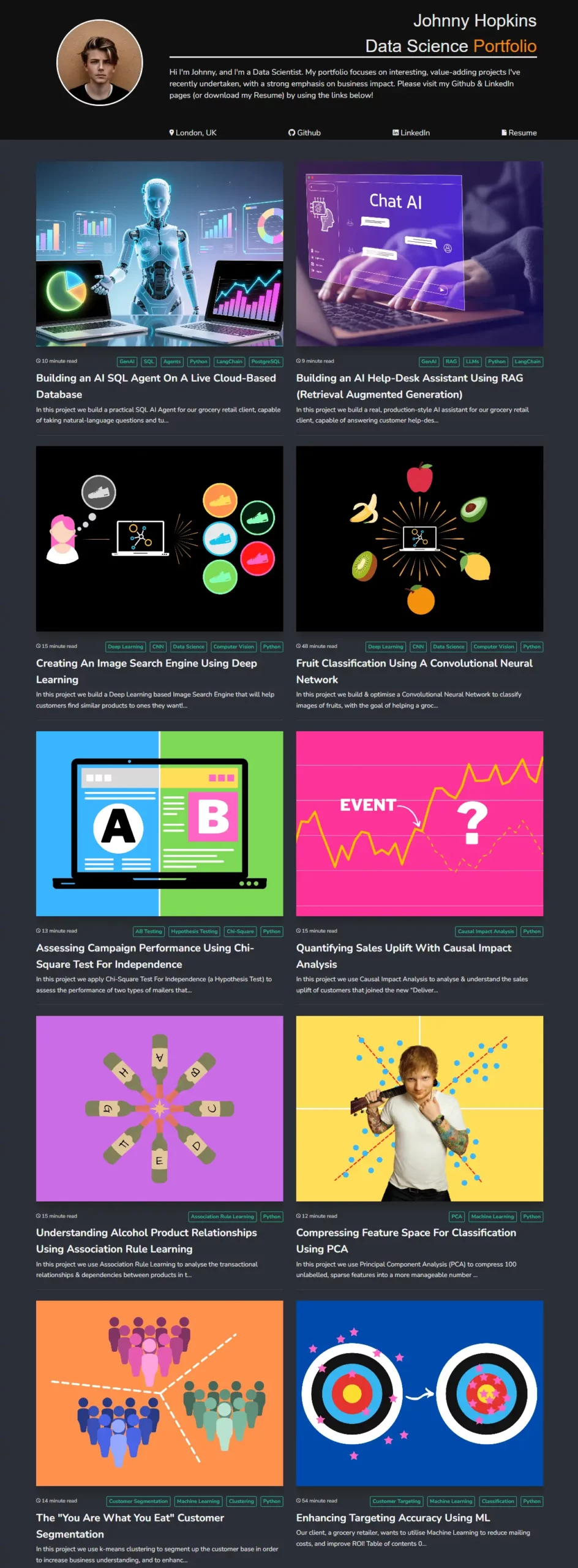
Inside that module, DSI students learn how LLMs, prompting, RAG, agentic AI, and modern coding agents like Claude Code and Codex really work, with the same focus on clarity, intuition, and hands-on application that runs through the whole programme. They also build standout real-world projects, including an AI help-desk assistant using RAG and an AI SQL agent connected to a live cloud database.
So this is not about pretending AI does not exist.
It is about learning Data Science, Analytics, and AI properly: the foundations first, the practical skills next, the portfolio to prove it, and the modern AI layer on top.
That is the route I believe ambitious learners should be taking now.
Final thought
AI does not mean the end of Data Science.
But it does mean the old approach is not enough.
Watching random tutorials is not enough. Collecting generic certificates is not enough. Learning AI tools without understanding the foundations is not enough.
The opportunity is still there.
In many ways, it is bigger than ever.
But the people who get ahead will be the ones who take the smarter route, build the right skills, and learn how to use AI as part of a much stronger professional toolkit.
That is exactly what Data Science Infinity was built to help you do.
Want to learn Data Science, Analytics, and AI in the right order? Explore the full Data Science Infinity curriculum and see how DSI helps you build the skills, projects, portfolio, and confidence to stand out in the GenAI era.