

On this page

Switch to a career in Data Science & AI in under 6 months

Learn what hiring managers actually look for, how to build a portfolio from scratch, and what it takes to get hired - without a degree.

Watch the free training

GenAI: What 200+ Hiring Managers Told Me

Andrew Jones

Founder & Lead Instructor, Data Science Infinity

Sep 2026

9 min

GenAI in Data Science

On this page

Switch to a career in Data Science & AI in under 6 months

Learn what hiring managers actually look for, how to build a portfolio from scratch, and what it takes to get hired - without a degree.

Watch the free training

I wanted to share something that I think will help cut through a lot of the noise out there right now around GenAI, especially in Data Science, Analytics, and AI.

Because if you spend any time on social media, you’ll probably see two extreme opinions.

One side says GenAI is going to replace everyone.

The other side says it is overhyped, pointless, and not worth worrying about.

As usual, the truth is somewhere much more useful.

And, importantly, much more practical.

What I asked

As I continue to do over time, I’ve been speaking with my network of 200+ hiring managers, team leads, and recruiters across Data Science, AI, and Analytics.

Different industries.

Different seniority levels.

Different types of teams.

But all hiring into these roles.

To get a clearer view of what is actually happening, I asked them three questions:

  1. How is your team currently using AI or GenAI in practice, and how has that evolved over the past 12 to 18 months?
  2. When you’re hiring for Data, AI, or Analytics roles right now, what skills or qualities are you actually prioritising in candidates?
  3. What differentiates the strongest candidates from the rest, and what common mistakes or misconceptions are you seeing?


I read through the responses myself.

But, as we’re talking about GenAI here, I also dropped them into ChatGPT and asked it to summarise the key themes.And honestly, it did a really good job.

The summary

This is the summary that came back

"Across the responses, there’s a pretty consistent theme: hiring managers aren’t that interested in candidates who have a skillset focused only on GenAI. What they keep coming back to is strong fundamentals.

People who are solid with data, statistics, and programming, and who can actually identify problems relating to the business or customer, and then plan appropriate ways to solve those problems.

GenAI is definitely being used, but more as a tool for certain situations, scenarios, or tasks, rather than something that replaces core skills. A lot of teams said they experimented quite heavily with AI over the past 12 to 18 months, sometimes trying to force it into places where it didn’t really fit, but things have settled down now. The focus has shifted back to what actually delivers value.

The candidates that stand out tend to be the ones who have that solid technical base, but also understand the newer tools well enough to use them when it makes sense."

I don’t know about you, but I find that really interesting.

Because it cuts straight through so much of what we see online.

Yes, GenAI matters.

Yes, it is changing the field.

Yes, candidates should understand it.

But no, hiring managers are not suddenly ignoring SQL, Python, Statistics, Machine Learning, experimentation, data handling, communication, and commercial thinking.

In fact, if anything, those things seem to matter even more now.

The Data Science Skills Employers Still
Care About In The AI Era

GenAI matters. But the people who win are the ones who pair it with strong fundamentals.

Download Your Copy

My 5 biggest takeaways

After sitting with the responses for a while, there were five key things that stood out to me.

1. Fundamentals are still incredibly important

This came through again and again.

  • SQL.
  • Python.
  • Statistics.
  • Data handling.
  • Experimentation.
  • Business problem solving.


These are still the core of the job.

Outside of very niche GenAI startups, companies are not hiring people simply because they “know AI tools”.

They are hiring people who can solve real problems with data.

That distinction matters.

Knowing how to use an AI tool can be useful, of course. But if you do not understand the underlying work, the tool can only take you so far.

  • If you do not understand Python, how do you know whether the code is correct?
  • If you do not understand SQL, how do you know whether the query is pulling the right data?
  • If you do not understand Statistics, how do you know whether the result actually means anything?
  • And if you do not understand the business problem, how do you know what to ask AI in the first place?

"The fundamentals are not becoming less important because of GenAI. They are becoming one of the biggest differentiators."

That is the part I think a lot of people are missing.

The candidates who stand out are not the ones trying to skip the foundations.

They are the ones who have the foundations, then use AI on top.

2. GenAI is a tool, not the job

Teams are using GenAI.

They should be.

I used it to help summarise the themes for this article.

But the key point from the responses was that GenAI is being used in specific situations where it adds value.

  • It is helping people move faster.
  • It is helping with coding.
  • It is helping with research.
  • It is helping with ideation.
  • It is helping with documentation, summaries, exploration, and workflow improvements.


But it is not replacing Data Analysts.

It is not replacing Data Scientists.

It is not removing the need for people who understand data, business problems, experimentation, and decision-making.

It is making good people faster and more effective.

That is a very different thing.

3. The past 12 to 18 months were a bit of a scramble

This was one of the most interesting parts for me.

A lot of teams were surprisingly honest.

Over the past 12 to 18 months, many felt pressure to “be using AI”.

  • So they tried things.
  • They experimented.
  • They forced AI into places where, in hindsight, it probably did not really belong.


And that makes sense.

When a technology moves this quickly, companies do not want to be left behind.

But what seems to be happening now is that the panic phase is settling down.

The focus is moving back to impact.

  • What actually saves time?
  • What actually improves decision-making?
  • What actually improves customer experience?
  • What actually makes a team more effective?


That is a much healthier place for the industry to be.

"The AI conversation is moving from hype to usefulness."

And that is good news for serious candidates.

Because serious candidates can show that they do not just know the buzzwords. They understand where these tools fit, when they add value, and when something simpler might be better.

McKinsey’s latest State of AI research tells a similar story: adoption is widening, agentic AI is growing, but many organisations are still working through the difficult jump from experimentation to scaled business impact.

4. Knowing when not to use AI is becoming a real skill

This came up a lot.

The strongest candidates are not the ones trying to use GenAI everywhere.

They are the ones who understand when it makes sense, and when it does not.

  • Sometimes the right answer is a simple SQL query.
  • Sometimes it is a dashboard.
  • Sometimes it is an A/B test.
  • Sometimes it is a basic regression model.
  • Sometimes it is a Random Forest.
  • Sometimes it might be a GenAI solution, a RAG system, or an AI agent.


But the value is in knowing which approach fits the problem.

That is what separates someone who is just playing with tools from someone who can genuinely add value.

And that is one of the biggest shifts I think we will see in hiring.

Candidates will need to show not just that they can use AI, but that they can use judgement.

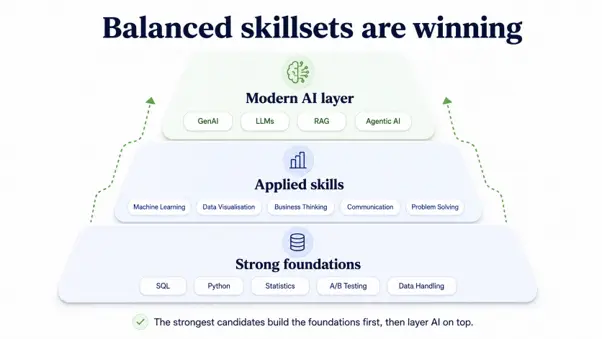
5. Balanced skillsets are winning

This was the biggest overall takeaway.

The candidates getting attention are not usually the ones who only know traditional Data Science.

And they are not usually the ones who only know GenAI either.

The strongest candidates are balanced.

  • They can work with data.
  • They can code.
  • They understand Statistics.
  • They can think through a business problem.
  • They can communicate clearly.
  • They can build projects.
  • They can explain their decisions.
  • And they also understand modern AI tools well enough to use them properly when needed.


That is the sweet spot.

Not “ignore AI”.

Not “only learn AI”.

But strong foundations, with the modern AI layer on top.

What this means if you want to move into Data Science, Analytics, or AI

If you are trying to break into this field right now, this should actually be reassuring.

Because it means you do not need to learn everything at once.

  • You do not need to become an expert in every AI tool.
  • You do not need to chase every new model, framework, or trend that appears online.
  • You need a clear route.
  • You need the right foundations.
  • You need practical projects.
  • You need to understand how the pieces fit together.


And then you need to learn how modern AI tools can sit on top of those skills, helping you move faster and create more value.

That is a much better strategy than jumping from tool to tool, hoping you are somehow covering the right things.

 "The key is not to learn everything. It is to learn the right things, in the right order, and understand how they fit together."


That is exactly how I think about the Data Science Infinity curriculum.

How this shapes DSI

This kind of information is incredibly valuable to me, because it helps keep DSI focused on what is actually in demand.

Not what is trending for five minutes on social media.

Not what sounds impressive in theory.

But what hiring managers, recruiters, team leads, and real data teams are actually looking for.

Inside DSI, students learn the fundamentals properly: SQL, Python, Statistics, A/B Testing, Machine Learning, Deep Learning, Cloud, data visualisation, and more.

They also learn GenAI, LLMs, prompting, RAG, Agentic AI, and Coding Agents.

But the order matters.

The foundations come first.

Then the AI layer.

Because without the foundations, GenAI is just another tool you do not fully understand.

With the foundations, it becomes something much more powerful.

It becomes an accelerator.

Final thought

So, what did 200+ hiring managers tell me about GenAI?

Pretty much this:

  • GenAI matters.
  • But fundamentals still win.
  • The market is not looking for people who have skipped the hard parts and learned a few AI tools instead.
  • It is looking for people who can solve problems, work with data, think clearly, communicate well, and use modern tools intelligently.


That is the opportunity.

And for people willing to build the right skills, in the right order, it is still a very exciting one.

Not sure what to learn first? Join my free Data Science & AI Career Webinar, and I’ll show you the smarter route into the field, including where GenAI fits, what hiring managers actually care about, and how to build a portfolio that helps you stand out.

Andrew Jones

Founder & Lead Instructor, Data Science Infinity

Andrew Jones is the Founder and Lead Instructor of Data Science Infinity, a CPD-accredited Data Science, Analytics, and AI programme helping ambitious learners build the skills, portfolio, confidence, and career strategy needed to stand out in the job market.

Andrew has spent over 15 years building Data Science, Machine Learning, AI, and Computer Vision solutions inside some of the world’s biggest technology companies, including Amazon and Sony PlayStation. He has developed 6 patented technologies across Data Science, Machine Learning, and Computer Vision, including technology used as part of PlayStation 5.

Alongside his technical career, Andrew has screened and interviewed thousands of Data Science and AI candidates, giving him a rare perspective on what actually helps people stand out, get noticed, and get hired. He is also the author of a book on Data Science & AI recruitment, and has built Data Science Infinity around the skills, projects, portfolio, and hiring strategy that employers genuinely look for.

Through DSI, Andrew has now supported 3,000+ students, built an online Data Science and AI audience of 250,000+ people across LinkedIn, YouTube, and Instagram, and continues to provide direct 1:1 guidance to students as they break into the field, move into higher-value roles, and build long-term careers in Data Science, Analytics, and AI.