

This is advice that is not always popular.
But if you’re serious about moving into Data Science, Analytics, or AI, I think it’s worth hearing.
When choosing how to learn, don’t only think about cost.
Think about ROI.
Because in a competitive market, the cheapest route can sometimes become the most expensive one.
Not because free content is bad. It isn’t.
Not because every paid course is good. It definitely isn’t.
But because the real cost of learning the wrong way is not always the money you spend.
It is the time you lose.
The mistake people make
For a long time, I believed the smartest move was to learn everything for free.
- More videos.
- More tutorials.
- More browser tabs open.
- More “I’ll just learn this bit first, then I’ll be ready.”
At the time, it felt productive.
But looking back, progress was painfully slow.
And after working in the industry, screening and interviewing candidates, and helping thousands of students move towards Data Science, Analytics, and AI careers, I’ve seen the same pattern play out again and again.
Some people take years of trial and error. Others get there in months.
And the difference is almost never intelligence.
It is rarely effort either.
The difference is focus, direction, support, and whether they are learning the right things in the right order.
"The most expensive thing in your career is not always paid learning. Sometimes it is time spent moving in circles."
Free and low-cost learning can look smart at first
I completely understand the appeal of free and low-cost courses.
YouTube is free.
Udemy is cheap.
There are endless tutorials, certificates, playlists, bootcamps, articles, newsletters, and AI tools that can help you learn something.
And any learning is good. I genuinely believe that.
But if your goal is not just to “learn a bit of data”, but to actually change career, land a role, increase your earning potential, and build a serious long-term career, then the question becomes different.
It is no longer:
“What is the cheapest way to learn?”
It becomes:
“What gives me the highest chance of getting the result I actually want?”
That is a much better question.
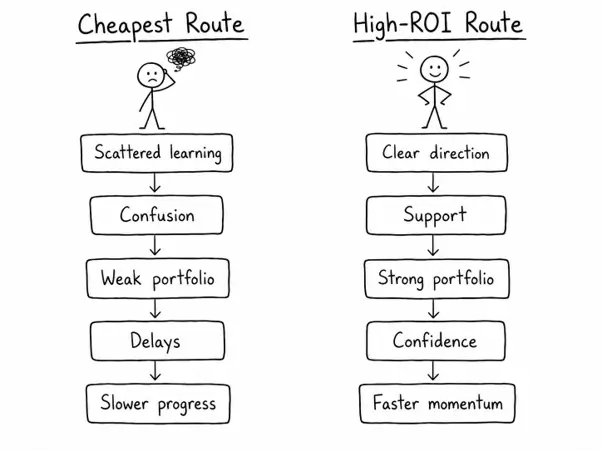
Because if the cheapest route takes you 12 months longer, creates more confusion, leaves you without a strong portfolio, and gives you no proper support through the hiring process, was it really cheaper?
Maybe not.
The opportunity cost is huge
Let’s think about it simply.
Imagine your first role in Data Science, Analytics, or AI pays somewhere between $60,000 and $140,000, depending on your location, background, role type, and level.
Now imagine one learning path gets you there 12 months faster than another.
That is not just a small difference.
That is potentially a full year of earning a strong salary, building experience, becoming more confident, and positioning yourself for the next role after that.
That is the opportunity cost people often forget to calculate.
They look at the upfront price of a programme and think:
“Can I save money by doing this myself?”
But the better question is:
“Could the right structure, support, portfolio, and hiring guidance save me months or even years?”
Because if the answer is yes, then the ROI calculation changes completely.
" If the right programme saves you 12 months of confusion, struggle, and delay, that can be worth far more than the cost of joining."
Why people get stuck
The problem with trying to piece everything together yourself is not usually that the content is bad.
A lot of free content is excellent.
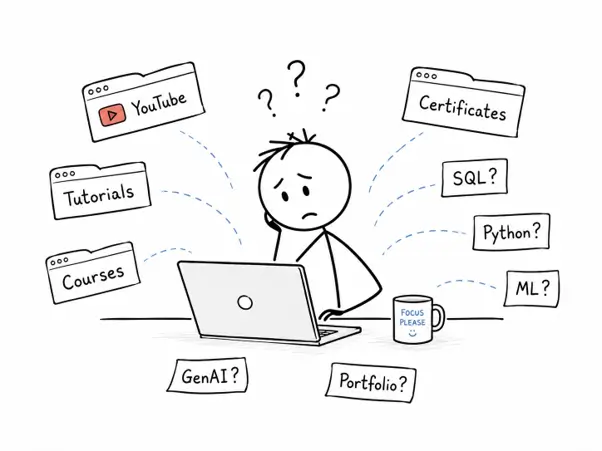
The problem is that there is too much of it, and very little of it is built around your actual outcome.
- You might learn some Python here.
- A bit of SQL there.
- A Machine Learning tutorial somewhere else.
- A dashboard project.
- A random certificate.
- A GenAI tool.
- A Kaggle notebook.
- A few interview tips.
But it doesn’t always join up.
You end up revisiting the same concepts, second-guessing what matters, wondering whether you have learned enough, and delaying the moment where you actually apply for roles because you never quite feel ready.
From a hiring perspective, that does not show up as dedication.
It just shows up as delay.
And in a market where lots of people are trying to break in, delay matters.
The risk of looking like everyone else
This is another thing people underestimate.
If you learn from the same low-cost courses as everyone else, build the same basic projects as everyone else, and collect the same generic certificates as everyone else, you risk blending in.
And blending in is dangerous.
Because the hiring process is not just about being “good enough”.
It is about being noticed.
It is about giving recruiters and hiring managers a reason to move you forward.
That means you need more than isolated tutorials.
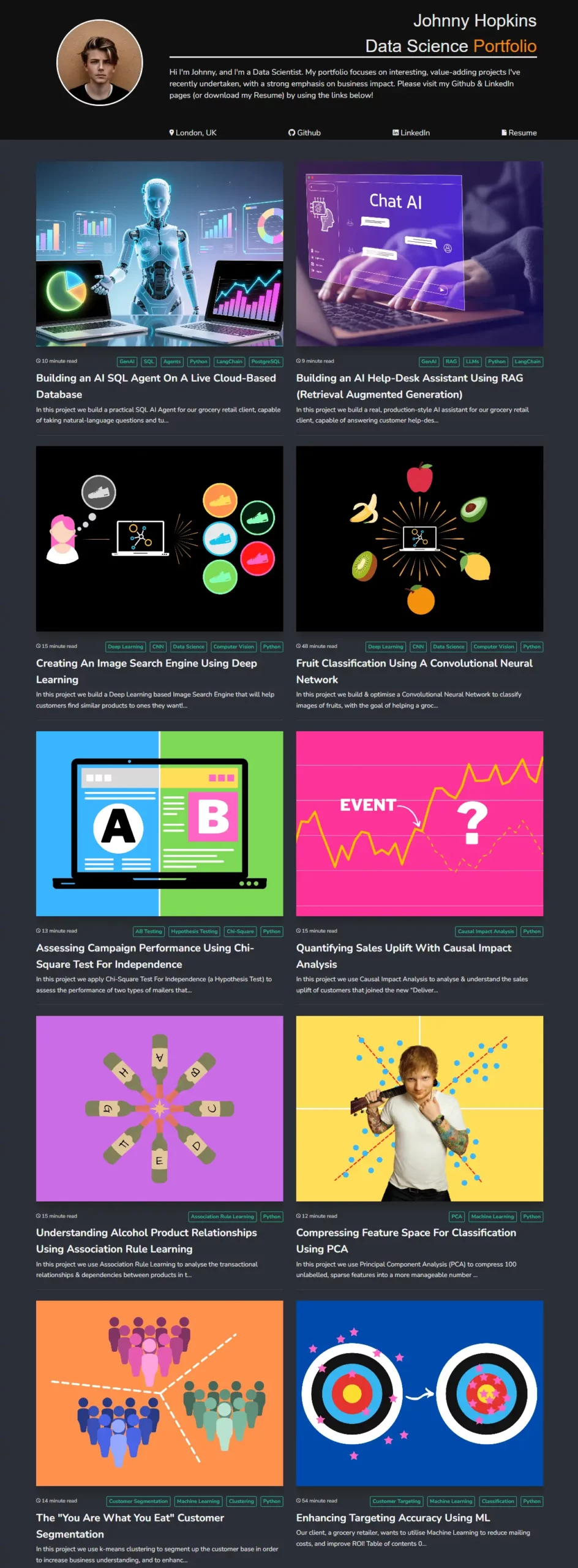
- You need a portfolio that shows real-world skill.
- You need projects that are varied, relevant, and easy to understand.
- You need to be able to explain what you built, why you built it, what decisions you made, and what value it could create.
- And you need to position all of that properly on your CV, LinkedIn, portfolio site, applications, and interviews.
That is where a lot of aspiring Data Scientists and Analysts fall down.
Not because they are not capable.
Because they do not have the right structure around them.
7 Questions To Ask Before Choosing
A Data Science & AI Course
A practical checklist for choosing the path that actually helps you become employable.
Download Your Copy
What a high-ROI learning path should give you
A strong learning programme should not just give you content.
Content is everywhere.
A high-ROI learning path should give you direction.
It should help you understand what to learn, what to ignore, what order to learn things in, and how each piece fits into the bigger picture.
It should teach the core skills that are still truly in demand: SQL, Python, Statistics, A/B Testing, data visualisation, Machine Learning, cloud, GenAI, and the ability to solve real business problems with data.
It should also help you build a portfolio that actually proves your skills.
Not just one massive capstone project that nobody has time to understand.
Not just in-browser tasks.
Not just toy exercises.
A proper portfolio.
A set of projects that show you can work through different types of problems, use different tools, explain your decisions, and create something that feels relevant to the real world.
And then, crucially, it should help you turn that learning into career progress.
- That means CV or resume guidance.
- LinkedIn positioning.
- Portfolio feedback.
- Interview preparation.
- Project storytelling.
- Support when you get stuck.
- Guidance when you lose confidence.
Because plateaus happen.
Confusion happens.
Rejections happen.
And trying to push through all of that completely alone is one of the main reasons people lose momentum.
" The people who move fastest are not rushing. They are deliberate."
This is why DSI is built differently
This is exactly why I built Data Science Infinity the way I did.
DSI is not designed to be another folder of videos.
It is designed to be a complete pathway for people who want to move into Data Science, Analytics, or AI properly.
- You learn the core technical skills.
- You build 12+ industry-relevant portfolio projects.
- You earn the DSI Data Science & AI Professional Certification through a CPD-accredited programme.
- You get lifetime access to the curriculum and future updates.
- You get access to the private members’ group.
- And you get direct 1:1 support from me, not just while you are learning, but as you move through the hiring process and continue building your career.
That matters. Because this journey is not just about getting through a course.
It is about giving yourself the strongest possible platform to get hired, move forward, and eventually step into bigger, better, and more lucrative opportunities.
Paid learning is not automatically better
I want to be really clear on this.
I am not saying free courses are bad.
They are not.
And I am not saying all paid courses are good.
They definitely are not.
A bad paid course is still a bad course.
A generic certificate is still a generic certificate.
A high price does not automatically mean high value.
The point is not “free vs paid”.
The point is ROI.
What are you getting for the time, energy, and money you invest?
Are you getting closer to the result you want?
Are you building skills that hiring managers actually care about?
Are you creating proof of your ability?
Are you getting support when you need it?
Are you learning how to present yourself properly?
Are you saving time?
Are you moving forward with confidence?
Those are the questions that matter.
Measure the decision in months gained
If you are serious about changing direction, measure decisions in months gained, not just money saved.
That is one of the biggest mindset shifts I think aspiring Data Scientists, Analysts, and AI professionals need to make.
Because yes, you can absolutely try to piece everything together yourself.
Some people do.
But if it takes you an extra 6 months, 12 months, or 18 months to become role-ready, that has a cost.
A very real one.
Not just financially, but emotionally too.
More confusion.
More second-guessing.
More false starts.
More time wondering whether you are learning the right things.
More time stuck at the back of the queue while other people are building stronger portfolios, getting better support, and moving faster.
Final thought
If Data Science, Analytics, or AI is a nice casual interest, then by all means, learn however you want.
Watch free videos.
Try random tutorials.
Explore tools.
Have fun with it.
But if this is a serious goal for you, and you genuinely want to build a career in this field, then I would think about it differently.
Do not cut corners just to save a few dollars.
Really go for it.
Invest in the route that gives you the best chance of building the right skills, the right portfolio, the right confidence, and the right career strategy.
Because the goal is not just to learn.
The goal is to get hired, keep growing, and build a long-term career in a field that can be genuinely exciting, future-focused, and lucrative.
That is the opportunity.
And that is why ROI matters far more than cost.
Want a clearer, higher-ROI route into Data Science, Analytics, and AI?
Read more about what it takes in today’s market in my blog post The Data Scientist 2.0: Roadmap For The GenAI Era.
Then, explore Data Science Infinity and see how DSI helps you build the skills, projects, portfolio, certification, confidence, and hiring strategy to stand out, without wasting months trying to piece everything together alone.